TalentOS vs Mem0: agent memory API or a shared workspace?
Mem0 gives an AI app or agent long-term memory through an API. TalentOS gives a team one place for skills, routines, connected apps and memory that their agents share. Here is how to choose.
By TalentOS
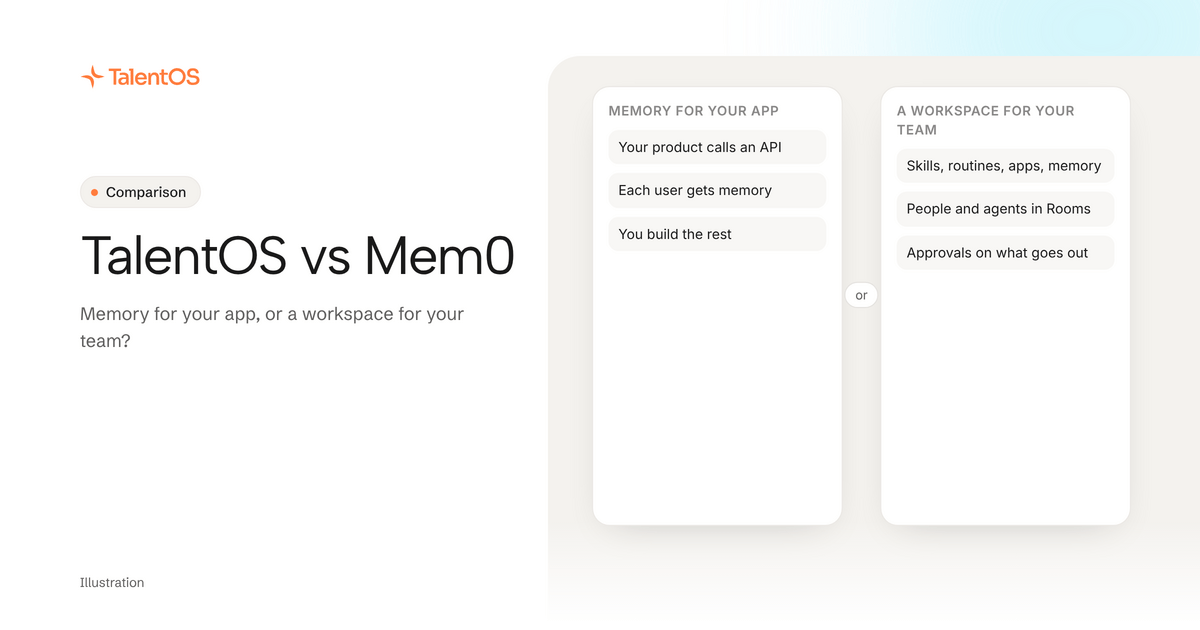
Pick Mem0 if you are a developer adding long-term memory to your own AI product or agent. Evaluate TalentOS if your team wants one shared place for its skills, routines, connected apps and memory, used by people and by the agents they already work with. Both can give Claude Code or Cursor memory that lasts between sessions, so the real question is who the memory is for.
We wrote this comparison from each product’s public documentation, checked on November 9, 2026. It is not a hands-on benchmark. Prices and plans change, so confirm them on each pricing page before you decide.
Who should pick Mem0?
Mem0
A memory layer for AI agents and apps, offered as a hosted platform with an API and SDKs, an open-source version, and OpenMemory, a self-hostable MCP server for tools such as Claude, Cursor and Windsurf.
Who should pick it: Developers who want to add long-term memory to their own AI product or agent, or give a coding agent memory through MCP.
Mem0 documents a free Hobby plan (10,000 memory adds and 1,000 retrievals a month), paid plans from $19 a month, a Pro plan at $249 a month that includes graph memory, and an MCP URL that plugs into Claude Code, Cursor and other MCP clients. The open-source version is Apache 2.0.
What to confirm: Check where memories are stored, which plan your request volume needs, whether you need the hosted platform or OpenMemory, and who on your team can read what an agent saved.
Sources: Pricing; Platform or open source; OpenMemory MCP; Memory for Claude Code. Public documentation checked 2026-11-09.
Mem0 is built for builders. Your product calls its API, each of your users gets memory that persists, and you decide what to do with it. If you are shipping an assistant, a support bot or an agent inside your own app, that is the job Mem0 is designed for.
Who should evaluate TalentOS?
TalentOS is a shared AI workspace. It keeps a team’s company context in one place: skills (how you like work done), routines (jobs that run on a schedule), connected apps like Gmail or HubSpot, and memory. People work in Rooms, shared spaces for a project or client, alongside their AI teammates and the agents they already use.
Claude Code, Codex and Cursor connect with one command, npx talentos@1 init. Once connected, an agent can search your memory, save new facts, follow your team’s skills and start your routines. Your AI teammate inside TalentOS uses the same context, on the model you pick.
Where they overlap
Both give a coding agent memory that survives the end of a session:
- Mem0 documents an MCP URL that plugs into Claude Code, Cursor and other MCP clients, plus OpenMemory, a self-hostable MCP server.
- TalentOS adds itself to Claude Code, Codex and Cursor, which can then search and save to your TalentOS memory.
If all you need is “remember this between sessions” for one developer, either can do the job.
Where they differ
Scroll to see all columns
| Question | Mem0 | TalentOS |
|---|---|---|
| Who it is built for | Developers adding memory to their own app or agent | Teams who want shared context for people and their agents |
| What you work with | An API, SDKs and an MCP server | A workspace with Rooms, plus a CLI and MCP for your agents |
| What it holds | Memories your app or agent saves and retrieves | Memory, plus skills, routines and connected apps |
| Who sees the memory | Whatever your product decides | Personal memory is private to you, Room memory to the Room, company memory to the workspace |
| How it is priced | Free Hobby plan, paid plans from $19 a month, Pro at $249 a month | Free plan, Team at $20 a member a month ($16 billed yearly), Business at $40 ($32 yearly) |
Mem0 prices are from its pricing page; TalentOS prices are from our pricing page. Your own agents connect to TalentOS on every plan.
Three questions that decide it
Are you building a product, or running a team? If memory is a feature you are shipping to your own users, Mem0 is the closer fit. If memory is something your colleagues and their agents need while they work, look at TalentOS.
Is memory the whole job? A coding agent that remembers your preferences is useful. But a team usually also needs the method for a weekly report, the report that runs every Monday, and access to the CRM. Our post on AI memory vs a company harness goes through that difference.
Who should see what? In TalentOS, your personal memory stays private, even from admins, and your agent never reads a teammate’s memory. With an API like Mem0, those rules are yours to design and build.
Can you use both?
Yes, and some teams will. A product team could use Mem0 inside the app they ship to customers, and TalentOS for their own work: the launch plan, the client updates, the skills their agents follow.
Try it on one real job
Pick one task your team repeats, like a weekly client update. Run it for a week in the setup you are considering, then ask a colleague to run it without help. The option where the second person gets the same result is the one that kept the right context.
To try TalentOS, paste this into Claude Code, Codex or Cursor:
Set up TalentOS for me. Run `npx talentos@1 init` and wait while I approve the sign-in in my browser. When it finishes, tell me to restart you so the TalentOS tools load. Then list my TalentOS skills and tell me what you can now use.
Read more about giving every agent the same memory, or see the company brain page.