TalentOS vs GBrain: one assistant everyone prompts, or one agent per person?
GBrain gives a team one shared assistant on plain Markdown files. TalentOS gives each person their own agent in shared Rooms. Compare and choose.
By TalentOS
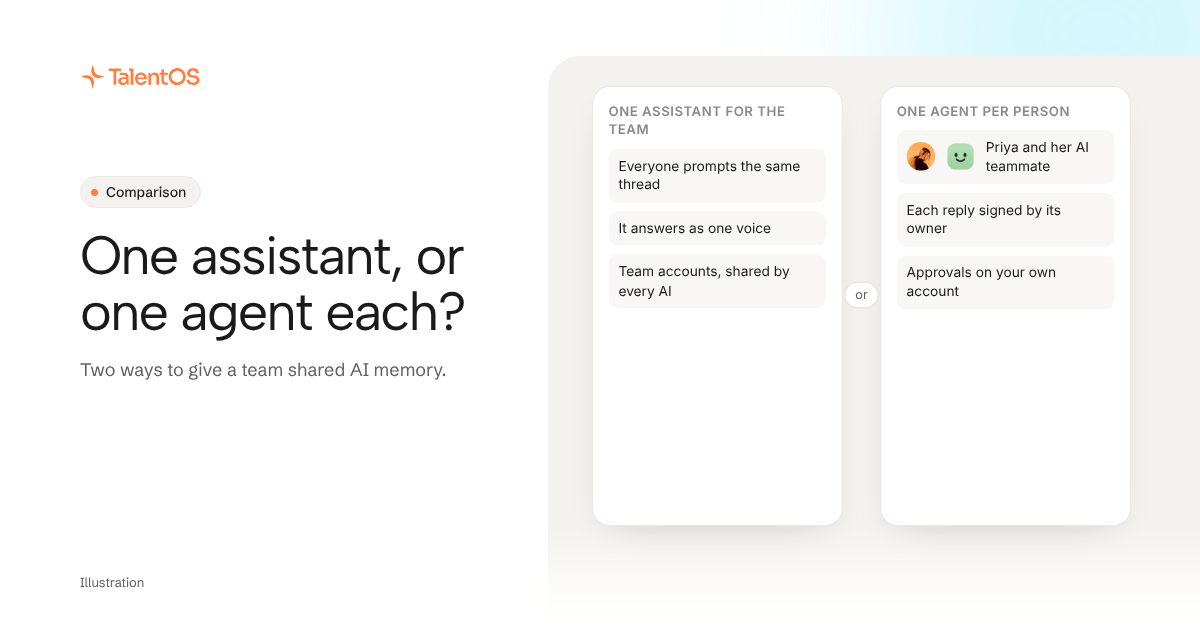
Pick GBrain if your team wants one assistant answering a shared thread, backed by a memory of plain Markdown files you can copy and host yourself. Pick TalentOS if each person should have their own agent, whose replies and approvals stay in their name, working beside colleagues in shared Rooms.
Both start from one observation: what a team knows is scattered across private chats, and one shared memory beats ten smart people with ten versions of the truth. The difference is who the AI belongs to.
We wrote this from each product’s own pages on November 17, 2026, not a hands-on test. GBrain described its plans in more than one way while we read them, so follow the pricing link instead of trusting a number here.
What does GBrain do well?
GBrain calls itself “the whole team’s memory, skills and accounts, in every AI the team uses”. Three things it does better than most:
- The memory is files you own. One Markdown page per person, company, meeting or idea, with what is true now on top and the history underneath. Copying the folder takes the memory with you. Its README is honest about the edge: “Markdown export is not a full database backup”, because database-only pages, unresolved facts and history live only in the database.
- A permission level per app, per AI. Gmail, Calendar, Stripe and several hundred other apps connect once for the team, and each AI gets Off, Read, Draft, Manage or Read & Write. A change takes effect at the next call, and every action lands on one record.
- A published memory score. GBrain reports that on LongMemEval, a public test of recall across past conversations, it found everything a question needed for 451 of 470. That is its own published run, with its harness published, so treat it as a claim you can check, not a neutral result.
It is open too: MIT licensed, free to self-host, with about 470 apps on its connectors page and any MCP server by address.
How are TalentOS and GBrain different?
GBrain puts one assistant in one workspace and the team prompts it together. “One AI the whole team prompts together”, its workspace page says, and “one assistant answering everyone”. Every message carries its author, so you see who asked and who added to the question.
TalentOS goes the other way. Each person has an agent of their own, and each agent belongs to that person. “Each agent belongs to one person,” its help center says. “It joins a room only when its owner adds it, and its owner decides who in that room can ask it for work.”
That one difference decides whose account acts, and whose yes counts.
The comparison
Scroll to see all columns
| Decision | GBrain | TalentOS |
|---|---|---|
| Who the AI belongs to | One assistant per workspace, prompted by the whole team, and one workspace per employee on Enterprise | One agent per person, plus the Claude Code or Codex they already run |
| Whose accounts it uses | Team accounts connected once, shared by every AI at a set level | Each person’s own connections, scoped to that person and that agent |
| What an answer is credited to | The assistant, with each message’s author kept | The person whose agent wrote it |
| Approvals | A permission level per app per AI; drafts can wait for a person to send | Per action per person: Ask first, Automatic or Off, and a few shared writes that are never automatic |
| Memory | Markdown pages in one team memory, personal memory kept separate | Personal, department and company memory, with a person approving what reaches company |
| Price | See GBrain pricing | Free for 3 Rooms and 5 people, then $20 per member a month, see plans |
What does each one cost you?
One assistant asks less of each person: a new colleague joins the thread and prompts it. It is also one voice: with twelve people in one thread, the record shows what the assistant did, not who set it going.
One agent per person makes approval mean something, because the account that acts belongs to the person who said yes. It costs attention instead: everyone has a model to pick and connections to make, and a team that skips that gets less out of it.
Ten people at an accounting firm
Ten people, one shared inbox.
On GBrain the team connects the shared accounts once, sets Draft on mail, and asks one thread for the week’s overdue invoices. A colleague adds what she knows mid-answer. The drafts wait until a person sends them.
On TalentOS the partner connects her own mailbox and the manager connects his. Each asks their own agent for their part, and both answers land in the client’s Room, signed by whoever asked. When the partner approves the email, the record shows she did, from her account.
If the firm’s problem is “nobody knows what anyone else learned”, GBrain fixes it faster. If it is “an email went out and nobody will say who approved it”, TalentOS fixes that.
Which one should you pick?
Pick GBrain if you want one shared assistant, one memory in plain files you can copy or self-host, and a team that will prompt it together.
Pick TalentOS if several people act on the same client accounts and you need to know who asked, who approved, and whose account it went out from.
Questions people ask
What is the difference between TalentOS and GBrain? GBrain gives a team one assistant in one shared thread. TalentOS gives every person their own agent, with those agents meeting in shared Rooms where each reply stays credited to its owner.
Can I use Claude Code, Codex or ChatGPT with either one? Yes: GBrain connects Claude, ChatGPT, Claude Code, Codex, Cursor and your terminal to one memory, and TalentOS seats Claude Code and Codex in a Room, each owned by the person who added it. Neither replaces the account you already pay for.
Which one keeps an approval attached to a person? TalentOS does: approvals are owner only, and each governed action carries that person’s own setting, Ask first, Automatic or Off, with money, credentials and a few shared writes never automatic. In GBrain it is a permission level on a shared account plus a record of every action.
Can we take the memory with us if we leave? GBrain’s memory is Markdown files in a folder you copy, with the database caveat above. In TalentOS documents and artifacts download any time, and a full workspace export is a support request.
Which is cheaper for a team of ten? TalentOS is free for five people and three Rooms, then $20 per member a month. GBrain prices a whole workspace rather than a seat, so check its pricing page.
Try one job in a week
Pick a repeating job two people touch, such as a client update. Run it in the product you are leaning toward, then ask the second person to do it alone. Whichever lets them finish alone kept the context where the team needed it.
Written from TalentOS’s and GBrain’s own pages, read November 17, 2026. This is a fit comparison, not a hands-on benchmark. Corrections to support@talentos.so.