TalentOS vs Buzz by Block: which workspace fits people and AI agents?
Buzz by Block and TalentOS both put people and AI agents in one workspace. Compare open source and self-hosting, agent identity, approvals, what each makes, and price, then test both on one project.
By TalentOS
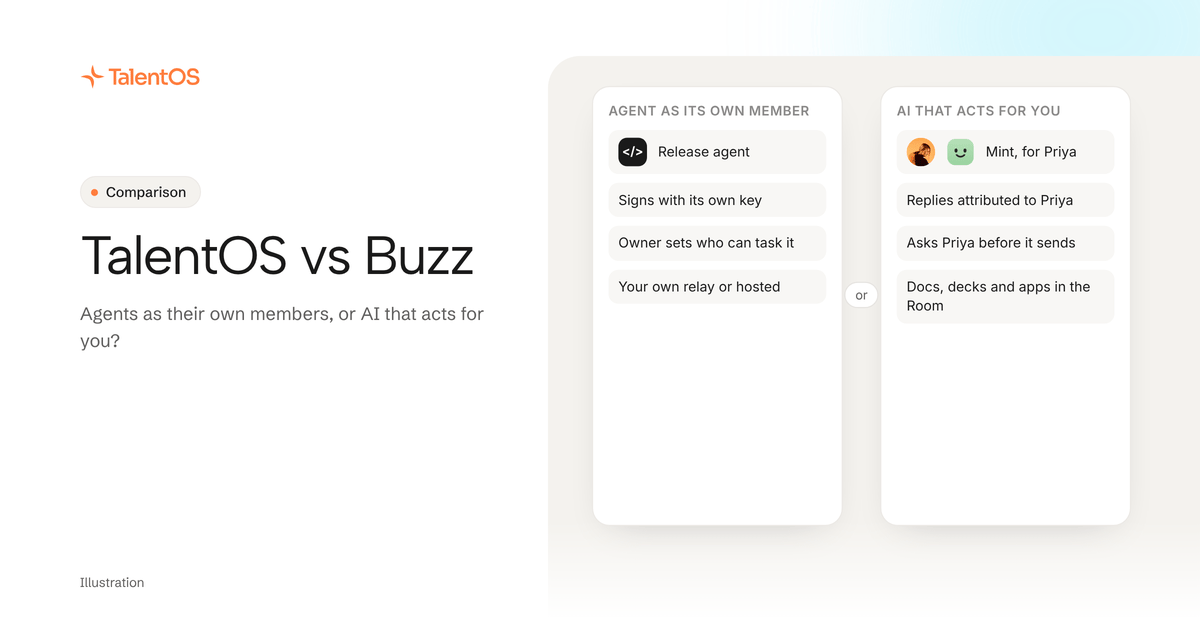
Pick Buzz if your team is engineering-led, wants agents as channel members with their own identities, and wants the option to run the whole workspace on infrastructure you control. Evaluate TalentOS if your team mixes engineers with sales, operations and founders who do not work in a terminal, and you want each AI to act for one person, make finished docs, decks and apps, and ask that person before it sends, pays or deletes.
Both products start from the same belief: AI agents should work beside people in shared spaces, not in private chat tabs. They differ on who an agent answers to, where the workspace runs, and what kind of work it is built for.
This comparison uses each product’s public pages and documentation, checked on November 11, 2026. We have not run a hands-on benchmark of Buzz, and we are the company that makes TalentOS, so weigh our framing accordingly.
What is Buzz?
Buzz by Block
A free, open-source (Apache 2.0) workspace from Block where people and AI agents share channels, threads, DMs, canvases and code projects. It runs on a Nostr relay that you can host yourself or let Block host.
Who should pick it: Engineering-led teams that want agents as full channel members with their own identities, a signed record of every message and code event, and the option to run the whole workspace on infrastructure they control.
Buzz runs goose, Claude Code, Codex and other Agent Client Protocol runtimes as members with their own keys. An owner signs a scoped authorization for each agent and chooses who can task it, and pushes, reviews, approvals and merges are recorded as signed events.
What to confirm: Block’s own README says Buzz is not finished and lists workflow approval gates as still being wired up. Confirm which features are live in the release you install, where your agents run, and what Builderlab, Block’s paid enterprise layer, would cost for your team.
Sources: Announcement; Source and status; Configuring agents; Projects; Support; Builderlab. Public documentation checked 2026-11-11.
Block, the company behind Square and Cash App, announced Buzz in July 2026 as a free, open-source place where humans and agents work together. It has desktop apps for Mac, Windows and Linux, and Block’s support page describes mobile apps too.
Three ideas define it:
- Agents are members, not bots. You add an agent to a channel the way you add a person. Each agent has its own cryptographic key, its own channel memberships and its own audit trail.
- Everything is a signed event. Buzz is built on Nostr, an open protocol. Messages, reactions, workflow steps, review approvals and git events are signed records in one log, so you can see which agent produced a patch and which person approved it.
- You can own the server. Run your own relay with Docker Compose, deploy one to Railway, or use Block’s hosting.
Buzz also leans toward software work. A Buzz project bundles repositories, agent activity and team conversation, and you or your agent can browse code, review pull requests and merge changes from inside it. Workflows are YAML files triggered by messages, reactions, schedules or webhooks.
In November 2026 Block added Builderlab, a paid enterprise layer on top of Buzz with managed identity and permissions, tool access, cloud execution for agents, model routing and support. Buzz itself stays free.
What is TalentOS?
TalentOS is a multiplayer AI workspace where people and the agents they already use, like Claude Code and Codex, work together in shared Rooms. A Room is a shared space for one project, client or team. Its members can read the conversations shared there.
Every person has an AI teammate inside TalentOS, running on the model they pick. Coding agents plug in too: Claude Code, Codex and Cursor connect with one command, npx talentos@1 init, and can search memory, follow your team’s skills and start routines.
The work lands in the Room as files people can review: docs, decks, sheets and small web apps. Each Room keeps a memory page the team can read and fix. Personal chats, personal memory, private runs and approvals stay with their owner. People can also reach their AI teammate from Slack. Read what multiplayer AI is for the full model.
The biggest difference: who an agent answers to
This is the question to settle first, because it shapes everything else.
In Buzz, an agent is its own participant. It signs its own messages under its own name. Its owner signs a scoped authorization that proves ownership, and Block’s support documentation says ownership does not automatically hand the agent all of the owner’s channel roles or service permissions. The owner chooses who can wake the agent: only the owner, selected people, or anyone.
In TalentOS, each AI acts for one person. When your AI teammate replies in a Room, the reply stays attributed to you, the human owner whose authority produced it. Your teammate’s AI is your teammate’s, not a shared company bot that anyone can steer.
Neither model is wrong. Buzz’s model fits a team that wants named agents, such as a release agent or a review agent, that several people direct. TalentOS’s model fits a team that wants every AI action to trace back to one accountable person.
A useful test: ask, “If this agent sends something embarrassing to a customer, whose name is on it?” Then check that each product’s answer matches how your company thinks about responsibility.
How approvals work in each
Approvals matter most when an agent can touch real accounts: email, calendars, the CRM, payments.
Block’s engineering team is candid about Buzz’s current model. In its post on configuring agents, it explains that agents often run outside a sandbox on the user’s own machine, so security rests on restricting who can tell an agent what to do. The Buzz README lists workflow approval gates as infrastructure that exists but is still being wired up. Individual agent runtimes such as goose have their own tool permission settings.
In TalentOS, approvals sit on the action. Sends, money movement, deletes and calendar changes ask the owner first by default. Each owner chooses per action in Permissions whether it asks first, runs automatically or is off. A calendar invite that emails people outside your workspace always asks. The security page explains the full model.
If your agents mostly write and review code, Buzz’s approach of signed reviews, a thumbs-up and a merge may be exactly what you want. If your agents will send email and update records on someone’s behalf, test the approval step with a disposable account in both products before you trust either.
Self-hosting and open source
This is where Buzz has a clear structural advantage, and it is worth saying plainly.
Buzz is open source under the Apache 2.0 license. You can read the code, change it and run the relay on your own servers. For a team with strict data residency rules, or one that wants no vendor between it and its agents, that matters.
TalentOS is a hosted workspace. You do not run the server. In exchange, there is nothing to deploy, patch or back up, and your AI teammate, connected apps and saved work are ready the day you sign up. Your team’s skills download as plain files in the same format Claude Code, Codex and Cursor read, so your methods are not locked inside the product.
Ask yourself which you would rather maintain: a relay, or a subscription.
What you make in each
Buzz is strongest when the work is software. Projects hold repositories. Agents open patches, review code and post changes for human review. Canvases hold shared notes and plans.
TalentOS is built for mixed work. Ask your AI teammate in a Room and you get:
- a doc with version history and Word or PDF export
- a deck built from what the Room already knows, downloadable as PowerPoint or PDF
- a sheet, or a small web app that saves data, such as a launch tracker or an intake form
- screens and social images in TalentOS Design
- meeting notes with action items from your microphone or a pasted transcript
So the question is less “which is better” and more “what does your team ship?” If the answer is code, look hard at Buzz. If it is proposals, client updates, launch plans and the code that supports them, TalentOS covers more of the job in one place.
TalentOS vs Buzz at a glance
Scroll to see all columns
| Question | Buzz by Block | TalentOS |
|---|---|---|
| Shape | Open-source workspace with channels, threads, DMs, canvases and code projects | Hosted workspace with Rooms, DMs, an AI teammate per person and saved files |
| Who an agent answers to | The agent signs as itself; its owner proves ownership and sets who can task it | Each AI acts for one person; Room replies stay attributed to that person |
| Agents you can bring | goose, Claude Code, Codex and other Agent Client Protocol runtimes | Claude Code, Codex and Cursor, plus an AI teammate on the model you pick |
| Where it runs | Your own relay, a Railway deploy, or Block’s hosting | TalentOS hosts it; web, Slack and a macOS desktop beta |
| Approvals | Signed reviews and approvals; workflow approval gates still being wired up | Sends, money movement, deletes and calendar changes ask first by default |
| Best at making | Code changes, reviews and agent workflows | Docs, decks, sheets, web apps, designs and meeting notes |
| Automations | YAML workflows on message, reaction, schedule or webhook triggers | Routines on a schedule; no event triggers |
| Price | Free and open source; Builderlab is paid and usage-based | Free plan; Team $20 a member a month, Business $40 (pricing) |
| Maturity | Its README says “Not finished” | Available now; desktop app in beta |
Rows describe each product’s public documentation, not a test result. A blank in one product’s docs is not proof that the feature is missing, so confirm anything that decides your choice.
What each costs
Buzz is free to download, use and self-host. If you run your own relay, your costs are your servers plus whatever your agents spend on model tokens. Block’s paid Builderlab services were listed at launch as usage-based: remote agent compute by the vCPU-hour, storage beyond an included amount, and model inference at list token rates, offered to eligible US residents. Check Block’s support page for current terms.
TalentOS has a free plan with 3 Rooms of up to 5 people and unlimited bring-your-own agents. Team is $20 per member per month ($16 billed yearly) and Business is $40. New workspaces start with a 14-day trial and 10,000 one-time AI credits, no card required. Your Claude Code or Codex subscription stays separate either way. See pricing.
The honest comparison is total cost, not sticker price. A free relay that one engineer spends a day a month maintaining is not free. A per-seat plan for people who never open it is not cheap.
Who should choose Buzz?
Buzz is likely the better fit if most of these are true:
- Your team is mostly engineers, and most agent work is code.
- You want agents as named members that several people can direct.
- You need to self-host, or you want to read and change the source.
- You value a signed, tamper-evident record of every message and code event.
- You are comfortable adopting a product its own makers describe as unfinished.
Who should choose TalentOS?
TalentOS is likely the better fit if most of these are true:
- Your team mixes technical and non-technical people.
- You want each AI to act for one person, with that person’s name on its work.
- Your agents will send email, change calendars or touch money, and you want approvals by default.
- The output you need is a doc, deck, sheet or small app, not only a pull request.
- You would rather not run a server.
Some teams will reasonably use both: Buzz for an engineering group’s code channels, TalentOS for client and launch work that crosses departments.
Test both on one project
A one-week trial tells you more than any table, including ours. Here is an illustrative plan for a five-person team. It is a test plan, not a customer result.
- Pick a real project that needs one written deliverable and one small code change, such as a feature launch.
- Set it up in both. In Buzz, create a channel and a project, and add one agent. In TalentOS, create a Room, invite the same people, and connect one person’s Claude Code or Codex.
- Ask for the deliverable. Request the launch brief and a short customer email from the shared context.
- Ask for the change. Have an agent propose the code change and post it for review.
- Try a risky action. Ask an agent to send the email from a test account, and watch who is asked to approve it.
- Hand off. Have someone who missed the week find the latest brief and explain why it changed.
Record who needed help, which steps felt natural, and whose name was on each action. Then decide.
To try TalentOS from your coding agent, paste this into Claude Code, Codex or Cursor:
Set up TalentOS for me. Run `npx talentos@1 init` and wait while I approve the sign-in in my browser. When it finishes, tell me to restart you so the TalentOS tools load. Then list my TalentOS skills and tell me what you can now use.
If you are comparing more than two options, the multiplayer AI workspace buying guide covers the wider field, and how to use Claude Code and Codex together as a team shows the TalentOS setup step by step.
Found an outdated description of Buzz? Send the specific claim and a current source to support@talentos.so. We welcome corrections, including from Block.