Open source or paid? How to choose a company harness
Should your company run an open-source company harness or pay for a hosted one? It comes down to who will host it, what the team plan really costs, and how much of your data it will hold. Plus the 8 basics any harness needs.
By TalentOS
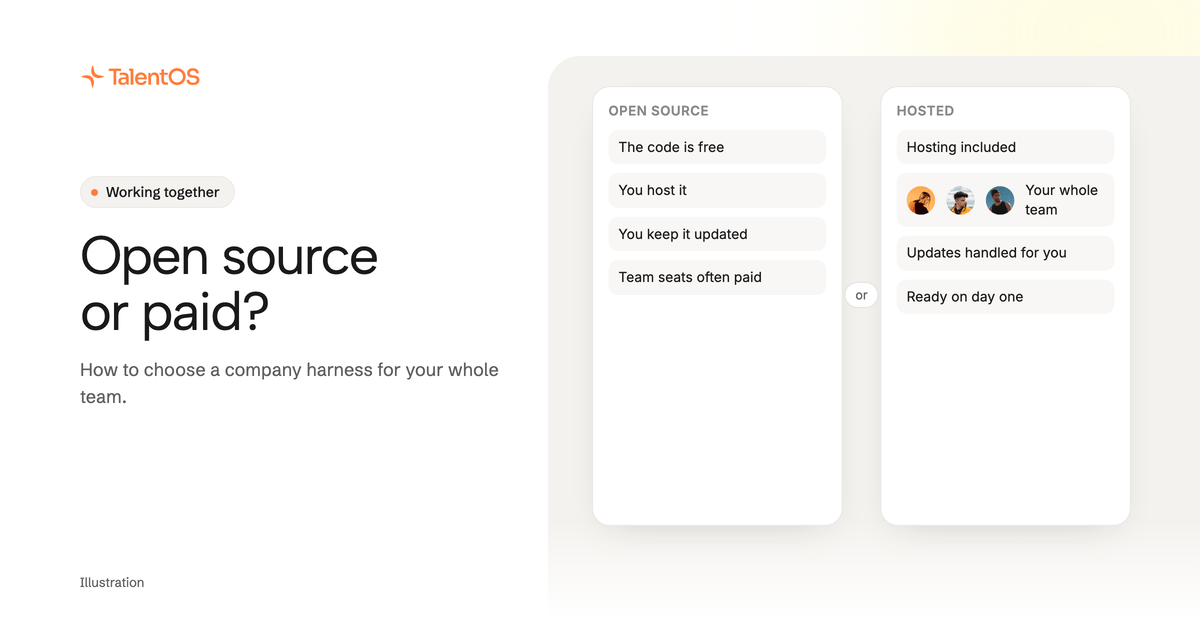
One of the most common questions business owners ask us is whether they should use an open-source company harness or pay for one. The short answer: open source is a good fit when you have a technical team that wants to run, host and maintain it. For most other companies, a hosted harness ends up costing about the same once you add hosting and team seats, and it is ready for your whole team on day one.
Watch on YouTube (8 minutes). Olivia Habart, our co-founder, answers the question and then walks through the 8 basics covered in this post.
What a company harness is
A company harness is the software around your AI. It wraps whichever model provider you use, such as Claude, ChatGPT or Gemini, and helps the AI run consistently for your company. It usually holds your skills (written methods your AI follows), your connections to the tools you already use, like Gmail, Google Drive or Apollo, and the shared space where your team works with AI.
For a longer definition, read what a company AI harness is and when you need one.
When open source works well
Open source usually means the code is free. That works well for a company that is mostly a technical team. They will run it themselves, host it themselves, and may even fork the repository and make their own changes. If that describes your team, an open-source harness can be a great choice.
The catch: someone has to host it
Open-source code is just the code. It does not tell you how it will run for your company.
You can clone a harness and start it on your laptop in a few minutes. But then it runs on your laptop, and nobody else on your team can reach it. To make it a company tool, someone has to put it on a server, keep it running, handle sign-in for every teammate, apply updates and fix it when it breaks. This is the part most people do not think about until they are already set up.
The open-core catch
Many open-source harnesses follow an open-core model. The core product is free, but the parts a company needs are paid: hosting, and access for multiple team members. A company harness is meant for the whole team, so you will almost always need those parts.
Unless you are a technical team that wants to build and run your own, you will eventually run into this. In the end it costs about the same as another provider, and you still carry more of the work.
Scroll to see all columns
| Open source | Hosted team plan | |
|---|---|---|
| The code | Free | Included |
| Hosting | You run it | Included |
| Your whole team | Usually a paid tier | Included |
| Updates and fixes | Your team | The provider |
Your data tilts the decision
A company harness gets more useful the more of your company’s data you put into it. That is the point of it. It is also why this is the tool where you most want people paying attention.
Model providers change their terms of service often, and the security landscape changes every day. Olivia’s view, from the video: if there is one AI tool you pay for, make it this one. She would rather pay a little more for a team whose job is to keep up with those changes than maintain a home-built setup that was designed for how things worked a year ago.
A quick way to decide
Answer these four questions about your company:
- Who will host it? If nobody on your team wants to run a server, look at hosted options.
- Who will keep it updated? Models, connections and security fixes change monthly. Name the person.
- What does the team plan cost? Compare the open-source project’s paid tier with a hosted provider at your real team size, not the free tier.
- How much data will it hold? The more it holds, the more you want a team whose job is keeping it safe and current.
If you have a technical owner for the first two and the numbers in the third favor open source, run it yourself. Otherwise, start with a hosted harness.
The 8 basics any company harness needs
Whichever way you go, check for these before you commit.
- Usage metrics. See how much each person uses and which models they use, without reading their conversations. This is how you keep cost under control.
- A shared library. One place where teammates share skills, routines and artifacts. A skill is a reusable method, a routine is a job that runs on a schedule, and an artifact is anything the AI makes, like a document or a deck.
- A place to collaborate. A shared space where your people and the AI tools they already use come together on the same work.
- Permissions. Control that goes down to the detail, including which models can do what, and what needs a person’s approval before it happens.
- Company memory. A memory layer above each person’s own, which every teammate’s AI can use. Admins should be able to edit it, and teammates should be able to suggest changes through a simple review.
- Activity and error logs. A record of what everyone’s agents did, and why something failed. Teammates use it to fix their work, and owners use it to see what is going wrong and trace security incidents.
- Knowing the model. Avoid tools that will not tell you which model they use. Different models have different privacy and security implications, and even two versions of the same model, say a 5.1 and a 5.2, can behave very differently. If you do not know the model, nobody can guarantee what happens to your data.
- Integrations. Connections to the tools your team already uses. This is what makes people actually adopt it.
Where TalentOS fits
TalentOS is a hosted company harness. We chose that direction because a company harness should work for your whole team from day one.
Your team works in Rooms, shared spaces for a project, client or team, where people and the agents they already use, like Claude Code and Codex, work together. Each AI acts for one person, and its work stays attributed to that person. Skills and routines can be shared across the team, and Room memory keeps a shared record of the project that members can check and correct. Owners choose, action by action, whether their AI asks first, runs automatically or is not allowed.
Try it
Take one real job your team repeats each week, and run it through the harness you are considering with two teammates. If the second person can finish the job without asking the first one how, the harness is doing its work.