Can an agent use your product without a human? We tested ours
We pointed an agent at talentos.so and told it to get TalentOS running without us. It got most of the way and stopped at three walls. Here is the audit, receipts included.
By TalentOS
Everyone is optimizing for AI answers right now, and almost everyone is solving the wrong half of it.
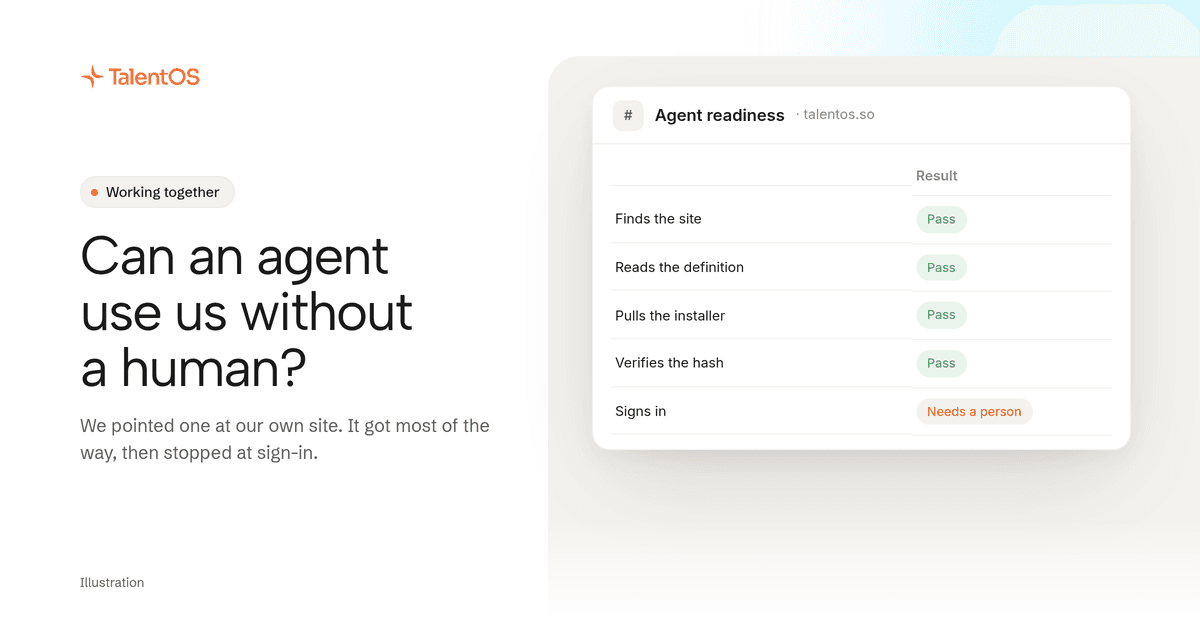
Short answer: no, not yet. An agent can find us, read our definition, download us and install us on a Mac. Then it stops at sign-in, because an account, a workspace and credits belong to a person.
There are two different questions hiding inside “AI discoverability.” Can an answer engine quote you? And can an agent actually use you? The first is marketing. The second is product. We had never checked the second one on ourselves, so I pointed an agent at talentos.so and gave it one job: get TalentOS running without me.
It got most of the way. Here is exactly where it got to, receipts included, because the wall is the interesting part.
What worked
The door is open. Our robots.txt lets every major AI crawler in: GPTBot, OAI-SearchBot, ChatGPT-User, ClaudeBot, Claude-User, Claude-SearchBot, PerplexityBot, Perplexity-User, Google-Extended, Bingbot. Only dashboard, auth and admin are blocked. Most companies our size have a wall up by accident. We did not.
We also have llms.txt and llms-full.txt, and they are genuinely written rather than generated: a plain one-line definition, the canonical page list, the current product facts.
Then the part that surprised me. The download page is server-rendered and the DMG link is anonymous. No sign-up, no JavaScript, no cookie wall. curl pulls it: a 207MB disk image, straight down.
There is also a machine-readable manifest at download.talentos.so/desktop/latest-mac.yml with the version, the file sizes and sha512 hashes, plus a .zip build that is far easier for an agent to handle than a disk image, because it just unzips.
Nothing on the site links to either of those two things.
That is the sentence worth sitting with. We had built a genuinely agent-readable layer, open crawlers, a written llms.txt, an anonymous binary, a hash manifest, and then told nobody it existed. Not our customers, not the crawlers, not the answer engines.
Where it stopped
Three walls, in order of how much they matter.
Platform. macOS only, 13 and up. An agent can install us if it has a Mac, and nothing else.
Identity. Sign-in is a browser handoff. An account, a workspace and credits all belong to a person. That is not a technicality, it is the shape of the product.
Interface. No MCP server, no public API, no CLI. So even with a Mac and a login, there is nothing for an agent to call headlessly.
Realistically, an agent’s job with us today is: find us, recommend us, download us, install us, then hand over to a human. Which is a decent job, and a much smaller one than the current conversation about agents implies.
The pricing problem was worse than the install problem
Our llms.txt used to say, of pricing: see the pricing page.
Answer engines do not follow a link and summarize it. They quote the sentence that already answers the question. So “how much does TalentOS cost” was being answered confidently, at length, without us in the answer. We had made ourselves uncitable on the single most-asked question about any product.
The fix is unglamorous: state the numbers. Free is $0. Team is $20 a member a month, or $16 billed yearly. Business is $40, or $32 billed yearly. Enterprise is custom. New workspaces get a 14 day trial with 10,000 one time credits, and extra credit packs run from 5,000 for $9.99 to 200,000 for $339.99. All of it in the same file the crawler is already reading, rendered from the same pricing module the pricing page uses, so a price change can never leave the agent-readable copy behind. That change is live; the pricing page itself is untouched.
The lesson generalizes: any fact you want an agent to repeat has to exist as a sentence somewhere a crawler can reach, in the same place your human page keeps it, or the two will drift and the drift will be invisible.
The thing I nearly got wrong
I almost wrote this as a post for agents.
Agents do not read blog posts. They read llms.txt, robots.txt, manifests and structured data. A blog post addressed to an agent is a message in a bottle thrown into a lake.
So this is for the humans who build agents, and for the answer engines that will quote it: here is what an agent-readiness audit actually looks like on a real product, including the part where we fail. Almost nobody publishes the honest version, which is precisely why the honest version is the one worth reading.
So can an agent use us without a human?
No. Not well, and I would not claim otherwise to look modern.
An agent can find us, read our definition, pull our installer, verify the hash, install on a Mac and tell a person it did. Then it stops, because the product is a workspace with people in it.
I do not think that is a gap to be ashamed of. A tool an agent can fully operate alone is a tool with no one in the loop, and the loop is the thing we are selling. The human in the middle is not friction in our onboarding. It is the product.
What we owe that human, though, is a shorter path from “an agent told me about this” to “I am inside it.” Right now an agent can do everything except the last step, and we had not written down the last step anywhere a machine could read it. Now we have.
If you are running the same audit on your own site, the two questions worth answering first are dull ones. Can a crawler read your definition in one sentence? And can an agent get your product onto a machine without a human typing anything? Most companies are two weeks of unglamorous work away from both, and they will never find out unless they go looking.